Facility Locksmith Training Syllabus

Row edge-slant Shape Decorative svg added to top

Class Information

Planning for the Class   Students will need to provide for their own accommodations and meals. Check the "Schedule" page for possible hotel group rate discounts. Attendees are not required to stay at the hotel if they can commute back and forth though it is recommended if the commute is more than 45 minutes one way. Classes will run from 8:00 a.m. to 5:00 p.m. Monday through Fri day. Students will be afforded a morning and afternoon break as well as a lunch break from 12:00 - 1:00 pm. There are often restaurants at or near the hotel.

About the Class   This is a highly structured and comprehensive course that is designed to provide the maximum training in the shortest amount of time possible. This allows us to provide the best value to your organization. Due to the amount of curriculum covered, it is imperative that the student is present and on-time every day. It is common for many students to spend time after class to study the material so plan accordingly. Instructors will be made available after-hours help to ensure that everyone has the best opportunity to pass. It is our goal to have 100% of the attendees successfully complete the course but, that is only possible with a mutual commitment.

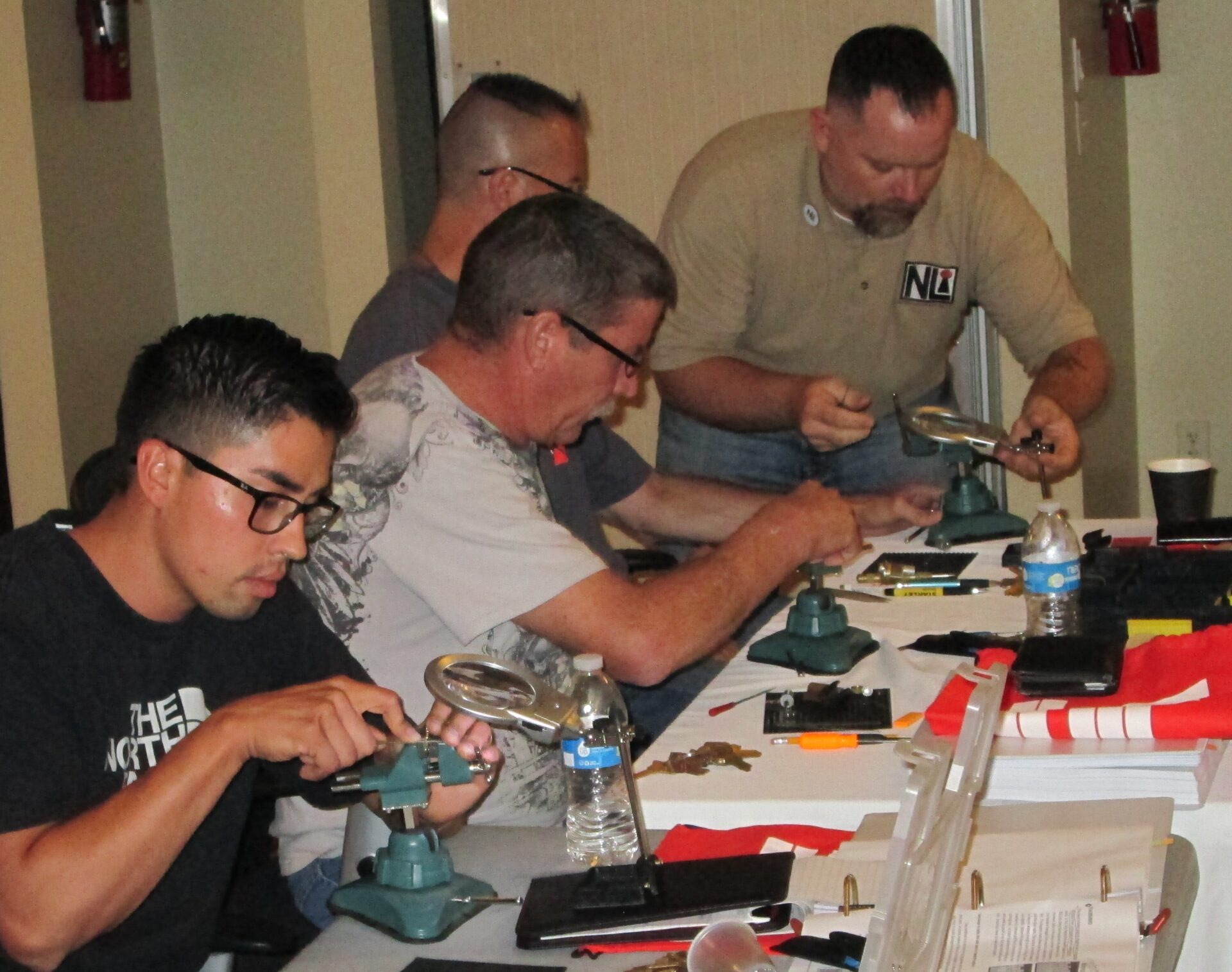
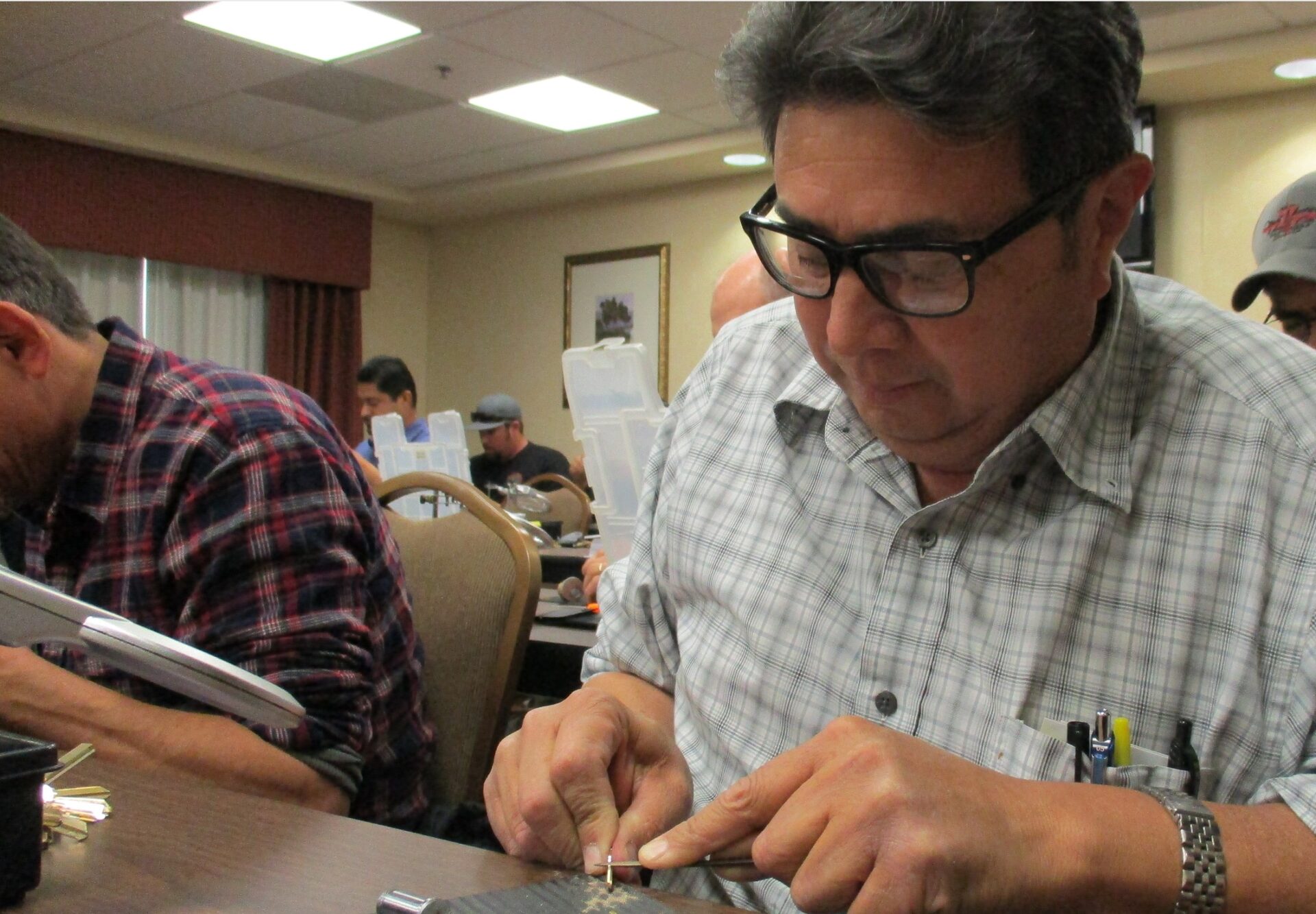
What to Bring  Tools will be made available to perform the required performance evaluations.  If you find reading glasses helpful sometimes, bring them to see to see small items. Highlighters and self-sticking tabs are helpful to identify important sections of your workbook.
IMG_1014r
Ontaro 3r
Row edge-slant Shape Decorative svg added to bottom
Day One Topics Covered

DAY 1

  • Program Requirements for Certification
    • Certified Facility Locksmith®
    • Registered Facility Locksmith®
  • State Laws Regarding Locksmith Licensing
    • Certification vs. Licensing
  • History of Mechanical Locks Devices
    • Ward
    • Bit
    • Levers (multi-bitting)
    • Wafer (a.k.a. Disc)
    • Pin
    • Wheel
  • Key Basics
    • Nomenclature
    • Brass vs. Nickle-Silver
    • DND Law vs. Patented Key Systems
  • Common Cylinders & Locking Hardware
    • Mortise Cylinders – Mortise Lock
    • Rim Cylinders – Surface Mount
    • Key-in-Knob/Lever – Cylindrical Locks
  • Ward Locks I
    • Construction and Limited Security Uses
      • Obtaining the Key Blank
      • Impressioning Wards
    • Bit Lock II
      • Construction and Limited Security Uses
        • Obtaining the Single-Bit Key
      • Lever Tumbler Locks III [DETENTION LOCKS]
        • Construction – Lifting Gates to Fence Height
        • Correctional Size Lever Locks
          • What does Paracentric mean?
          • Detention Lever Locks
            • Single Cylinders and Key Blanks
            • Double Cylinder and Key Blanks
          • How to Order Replacement Keys and Levers
          • Safe Deposit Boxes (2 sets of levers, 2 fences in tandem)

<Lunch break>

  • Wafer (disc) Tumbler Locks IV
    • Construction and Uses
      • Automotive
      • Common Furniture, Cabinets, Desk and other Cam Locks
        • Fort Lock
        • National Cabinet
      • Introduction to Picking Techniques
        • Picking Wafer Tumbler Cam Locks
      • Know the Handing of a Door
      • Astragals and ALL the Purposes
      • Door Coordinators
        • Construction and Purposes
      • Frame Openings
        • Installation and Construction
        • Knock Down vs. Welded
        • Thresholds and Door Bottoms
      • Doors
        • Construction
        • Cores
        • Seam/Seamless
        • Beveled Edge
        • Lites, Louvers and Reinforcements
Day Two Topics Covered

DAY 2

  • Hinges
    • Butts
    • Continuous
    • Swing Clear
  • 5-Steps to Door Alignment
    • Frame Square
    • Fasteners
    • Hinge Warp
    • Worn Hinges
    • Hinge Shims
  • Alternative Entry Techniques
  • Flush-bolt Hardware
    • Manual Bolt
    • Automatic Bolt
    • Constant Latch
  • Anti-ligature Hardware
  • Door Closers

<Lunch break>

  • American National Standards Institute (ANSI)
    • ANSI 86 and 161 Lock Preparation
  • ANSI/BHMA Materials & Finishes
  • ANSI/BHMA Lock Hardware Standards
  • Broken Key Extraction
  • Pin Tumbler Locks V
    • Construction
    • Hands-on
    • Make a Key
  • Manipulating Pin Tumblers
    • Traditional Picks
    • Impact Methods
    • Jiggler and Try-out
    • Pick Resistant Pins
Day Three Topics Covered

DAY 3

  • New Facility Construction
    • Owner, Architect and Contractor Relationship
    • Owner Specification Manual
    • Hardware Schedule
    • Bids, Submittals and Change Orders
  • Manufacture Specifications
    • Specification Charts
      • Pin Diameter, Gauge Point, and Spacing.
      • Depth of Cut, Flat Space, Cut Angle & M.A.C.S.
      • Pin Diameter and Length and Shape of Bottom Pin
    • OEM vs. Universal Pin Kits
  • Master Key Systems
    • Master Key System Levels
    • Sectional Master Keying
    • Blind and Direct Code Markings
    • Selective Master Keying
    • Single Keyed Different
    • Code Progression
      • Single Step Progression
      • Two Step Progression

<Lunch break>

  • Code Progression Exercises
    • Build a Level 2 & 3 System
  • Identifying Sub Masters in an Existing System
  • Recovering a Lost Master Key System
  • Creating Pin Setup Charts
  • Key Duplication/Key Machines
  • How to Get Unknown Codes/Bittings
  • Key Control Software
  • Electronic Key Custodian Machines
Day Four Topics Covered

DAY 4

  • Kwikset Residential Cylindrical Locks
    • Hands-On Rekey Exercise
  • Commercial Cylindrical Locks
  • Rekeyable Padlocks
  • Lubricants, Wet/Dry
  • Wheel Tumbler Locks, Combination VI
    • Gates and Fence
  • NFPA 101® Life Safety 101 Chapter 7 – Means of Egress
    • Authority Having Jurisdiction
    • Exit Access – Exit – Exit Discharge Door Requirements
      • Unoccupied vs. Occupied One-Motion Release
      • More Than One Means of Egress
      • Panic and Fire Exit Special Requirements
      • Occupancy Classification and Exceptions

<Lunch break>

  • NFPA 80® Fire Door Assembly Inspections
    • Independent Testing Laboratories and Certifications
      • Approved Self Closing Devices
      • Approved Hold-Open Devices
    • Basic Requirements:
      • Self-Closing and Self-Latching
      • Fire Rated Glass and Glazing Bead Requirements
      • Hardware Installed per Label
      • No Open Holes in Frame or Door
      • Door Clearance
      • Smoke Gaskets
      • Protection Plate Limits
    • Replacing or Retrofitting Hardware on Fire Rated Doors
      • Repairing Holes up to 1-inch
    • Modifications That Will Void the Label Certifications
    • Annual Fire Door Assembly Inspections, FDAI
  • Americans with Disability Act Requirements for Openings
    • History of Adaptation 1992, 2003, & 2010
      • New Construction, Alterations and Accommodations
      • Access to Primary Function Area Requirements
        • Opening Force Limitations
        • Door Close Speed Limit
        • Threshold Limit
        • Maneuvering Operational Parts
        • Surfaces Lower than 10-inches on Push Side
        • Clearance for Maneuvering Around Openings
      • Key Blank Control and Drill/Pick Resistant
        • Check Pin (Everest®, Coremax®, Kabba Peaks®)
        • Sidebar (Medeco®, Primus®, Assa Abloy®)
      • Barrel Pin Tumbler Locks (Chicago ACE Style)
        • Construction and Overview
        • Picking and Drilling Barrel Locks
      • Review Pin Setup Charts
        • Hands-on Master Key Exercise
Day Five Topics Covered

DAY 5

  • Decoding an Existing Top Master Key
  • Interchangeable Cores
    • Small Format Interchangeable Cores, SFIC
      • BEST® Style Compatible Cores
    • Large Format Interchangeable Cores, LFIC
      • ASSA®
      • Corbin Russwin®
      • Sargent®
      • Schlage®
      • Medeco® 31/32
      • Yale®
    • SFIC Systems – A2, A3, and A4
      • Calculation Pin Segments
      • IC tools
      • Drilling Cores
      • Decoding the Control
      • Creating a Modified Control
    • Knox Box Construction and Purpose
    • Key Trap Box Construction and Purpose
    • Mortise Locks
      • Full Stile Construction – Case/Trim Components
        • Older Style (prior 2012)
          • Field Handing/Bevel Change
        • Newer Style
          • Field Handing/Bevel Change
        • Narrow Stile – Storefront Doors
          • Deadbolt, Hookbolt and Deadlatches
          • Anchoring Methods
          • Header/Threshold Bolt Retrofitting
          • Bottom Rail Deadbolt
        • Cylinder Deadbolts

<Lunch Break>

  • Miscellaneous Door Hardware – Protection, Fillers, Wraps, and Knockers
  • Exit Hardware
    • History and Purpose for Push-Through Egress
    • Panic vs. Fire Exit Device Hardware
    • Hardware Construction
      • Crossbar/Touchbar/Integral
      • Rim/Vertical Rod/Mortise
    • Latch Driver – Lever or Key Blocks Lever
    • Trim Selection to Complete the Function
    • Applications
      • Single Door
        • Rim Exit Hardware
      • Double Doors
        • Rim x Rim x Mullion
        • Vertical Rod x Vertical Rod
        • Vertical Rod x Rim
        • Vertical Rod x Mortise
      • Closing Dialog
      • Test Completion